
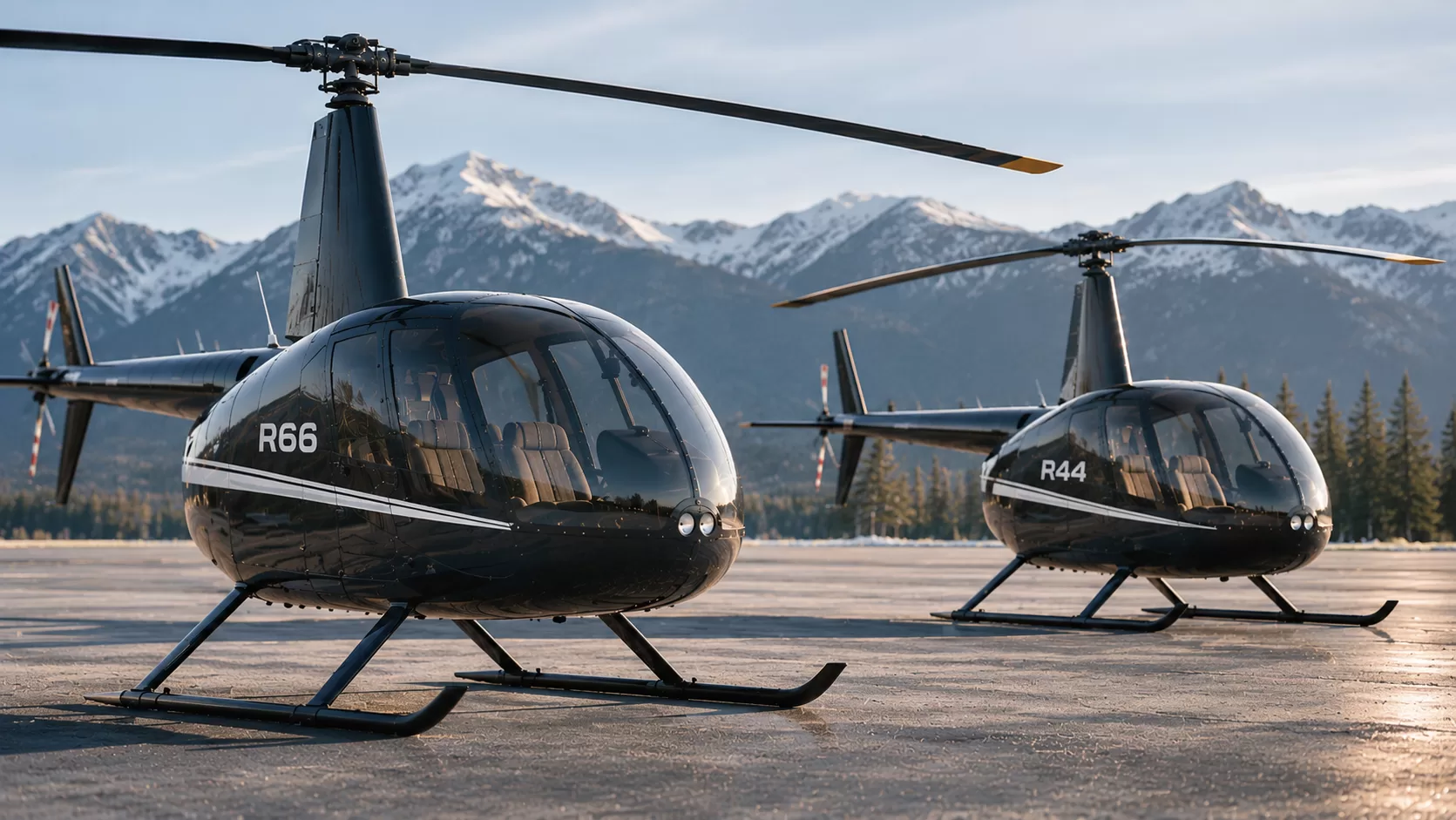
Most buyers who are looking at a Robinson end up asking the same question: should it be the R44 or the R66?
The R66 is the bigger, more powerful turbine. The R44 is the proven piston that has been one of the best-selling helicopters in the world for decades. Neither is the better helicopter in general. Each is the better helicopter for a particular kind of flying, and the wrong choice usually comes from buying for an occasional mission rather than the everyday one.
This guide compares the two the way an owner would: what they can carry, where they perform, what they cost, and how ownership differs.
The Short Answer
The R44 is the lower cost way into Robinson ownership. It is simple, widely supported, and a strong fit for private flying, training and general touring.
The R66 is the aircraft to look at when you need more payload, more room, more range, or more performance in heat and altitude, and you are comfortable with higher purchase and operating costs. In our experience it also cruises a little faster, and its auxiliary fuel tank options suit northern and remote flying. That is a common situation in the Rockies and across Western Canada.
R44 vs R66 at a Glance
The figures below are approximate and vary by model, equipment and conditions. They compare the R44 Raven II with the R66 Turbine. Always confirm specifications for the specific aircraft you are considering.
| ** ** | R44 Raven II | R66 Turbine |
| Seats | 4 (pilot + 3) | 5 (pilot + 4) |
| Engine | Lycoming IO-540, fuel injected piston | Rolls-Royce RR300 turbine |
| Fuel | 100LL avgas | Jet A / Jet A-1 |
| Cruise speed | about 110 kt (204 km/h) | about 110 kt (204 km/h) at max gross weight; in our experience about 5 to 7 kt faster than the R44 on average |
| Max gross weight | 2,500 lb (1,134 kg) | 2,700 lb (1,225 kg) |
| Useful load | about 1,000 lb (450 kg) | about 1,300 to 1,430 lb (590 to 650 kg) |
| Baggage | smaller compartments | 300 lb (136 kg) compartment |
| Typical range, no reserve | about 300 nm | about 325 to 350 nm; up to 4 hours of flying with the smaller auxiliary tank, up to 5 hours with the larger |
| Fuel burn | about 60 L/h (15 US gal/h) | about 76 L/h (20 US gal/h) in our experience; published figures vary, roughly 65 to 90 L/h |
| Hover ceiling | lower | over 10,000 ft at max gross weight |
| Overhaul timing | 12 years / 2,200 hours (extension announced for qualifying aircraft) | 12 years / 2,000 hours (some components extended to 4,000 hours in 2024); engine also limited to 3,000 start cycles |
Sources for the published figures are listed at the end of this article. The R44 fuel burn is our own rule of thumb from our operating costs guide. The R66 fuel burn and the cruise speed difference come from our own flying experience.
Performance: Where the Turbine Earns Its Place
On a cool day at low elevation, the two helicopters feel more alike than the spec sheets suggest, and both are easy to fly. Speed is where we notice a small but consistent difference. In our experience the R66 is faster by about 5 to 7 knots on average. Like most aircraft, both slow down when they are heavy and pick up speed as the fuel burns off and the weight comes down.
Range is the other big difference. The R66 reaches roughly 325 to 350 nm on standard tanks, and its two auxiliary fuel tank options stretch that further: up to 4 hours of flying with the smaller tank and up to 5 hours with the larger one. For northern and remote operations, where the next fuel stop may be a long way off, that extra margin can change what is possible.
The difference shows up when conditions get harder. A turbine holds its power better in heat and at altitude than a piston engine, which is why the R66 hovers well above 10,000 feet at maximum gross weight. If you fly in the mountains, from a high elevation base, or on hot summer days with a full load, that margin is the main reason people choose the R66.
If most of your flying is at lower elevations, with one or two people, the R44 gives up very little in everyday performance.
There is also a difference in feel. The R44 is snappier and more agile. The R66 has larger, heavier rotor blades with more inertia, and a turbine to manage, so it asks for a little more preparation. Many first-time R66 pilots overshoot the landing compared with flying the R44.
Payload and Cabin: The Biggest Practical Difference
The R66 carries a lot more than the R44. Its useful load is roughly 300 to 400 pounds greater, it has a fifth seat, and its 300 pound baggage compartment is large for a helicopter this size.
That matters more than it sounds. Payload is not just passengers. It is passengers, baggage, survival gear and fuel, all at once. An owner who regularly flies four adults with bags will feel the R44’s limits. An owner who flies one or two people with light gear may never notice them.
The R66 Utility also offers an external cargo hook with a capacity of up to 1,200 lb (544 kg), which opens up work the R44 cannot do.
Cost: Purchase Price, Fuel and Insurance
The R66 costs more at every step.
Purchase Price
A turbine is a larger investment than a piston helicopter, both new and used.
Fuel
The R66 burns more fuel per hour, and for many owners fuel is the most visible variable cost. Jet fuel and avgas are priced differently, so compare current prices at your home base rather than relying on a generic chart. In our experience the R44 burns about 15 US gallons per hour and the R66 closer to 20.
Insurance
Hull insurance is based on the value of the aircraft, so a higher-value R66 generally means a higher premium. Pilot experience and training history matter for both. First-time owners should price insurance before they buy, not after.
Hourly Reserves
Components on both helicopters have hour and calendar limits, and the cost of those limits needs to be reserved for every hour you fly. We cover how this works in The Real Cost of Owning a Robinson R44. The same logic applies to the R66, with different numbers.
Maintenance and Overhaul Timing
Both helicopters follow a scheduled inspection program plus an annual inspection required by Transport Canada, and both run on the two clocks of flight hours and calendar time. The details differ.
The R44 is a piston helicopter with a long-established maintenance pattern, covered in How Maintenance Works on a Robinson R44. Its overhaul comes at 12 years or 2,200 hours, whichever comes first. Robinson has announced an extension for qualifying aircraft, so confirm applicability before building it into a purchase decision.
The R66 uses a Rolls-Royce RR300 turbine, with an engine overhaul interval of 2,000 hours or 3,000 start cycles, whichever comes first (more on that below). When the first R66s reached their 12-year calendar limit in 2023, Robinson introduced a streamlined 12-year service for the type. In September 2024, the FAA approved doubling the service life of 12 R66 components from 2,000 to 4,000 hours and extended main and tail rotor blade calendar life from 12 to 15 years. Which aircraft qualify depends on serial number and configuration.
In both cases, the same principle applies. The hours and years remaining before the next major event are a large part of what an aircraft is worth, and a low-hour aircraft with little calendar time left is not a bargain by default. Our guide The Hidden Cost Most Robinson R44 Owners Never See explains why.
Engine Start Cycles Matter
The Rolls-Royce RR300 turbine in the R66 is limited to 3,000 start cycles or 2,000 operating hours, whichever comes first, before it needs its major scheduled engine maintenance.
Those two limits line up at an average of about 40 minutes of engine operation per start.
Flights shorter than that use up the cycles first. An operator averaging just 20 minutes of engine operation per start would reach the 3,000-cycle limit at only 1,000 engine hours, well before the 2,000-hour limit.
The Lycoming O-540 and IO-540 piston engines in the R44 have no specified start-cycle overhaul limit.
For flying built around frequent short flights, with many starts and shutdowns, that gives the R44 a meaningful maintenance advantage.
Longer Maintenance Intervals
The R66 has an edge in how often it needs to visit the shop.
The R44 needs an engine inspection and servicing every 50 hours, including oil and filter changes. The R66’s regular inspection interval is 100 hours.
Both helicopters also require a comprehensive inspection every 100 hours, but skipping the intermediate 50-hour visit can mean less downtime and fewer trips to the maintenance facility.
That matters most for owners who fly a lot of hours each year, or who operate away from a maintenance facility.
Fuel and Logistics
The R44 burns 100LL avgas and the R66 burns jet fuel. Both are available at many airports, but they are not always sold in the same places. If you plan to fly cross-country or operate from remote sites, check where you can actually refuel along your usual routes before you choose. Winter adds fuel requirements for the R66, covered in Getting Your Robinson R66 Ready for a Canadian Winter.
The R66 also operates differently from the R44 in cold weather. It is a turbine with no carburetor, and it has passed the snow test required to fly in falling and blowing snow. The Raven II is fuel injected, but earlier carbureted R44s carry carburetor ice risk in cool, humid conditions. Our R44 winter guide covers both: Getting Your Robinson R44 Ready for a Canadian Winter.
Availability and Resale
The R44 has an active used market and is widely available. The R66 market works differently. At the time of writing, the expected delivery timeline for a new R66 through our dealership has been in the range of two to three years, so confirm current timelines with us. Buyers who need an aircraft sooner may pay close to the price of a new aircraft for a desirable used R66 that is available immediately.
Some of our clients have bought new R66s, flown them, and later sold them into a strong market with relatively little depreciation. That outcome is not guaranteed. It depends on the purchase price, age, hours, condition, component status, equipment and market conditions at the time of sale. The same factors apply to the R44, as we explain in What Actually Lowers an R44’s Resale Value.
Which One Fits Your Flying?
Use this as a starting point, not a rule.
The R44 Is Usually the Better Fit If
- You fly mostly one to three people at low to moderate elevations
- You fly fewer than about 100 hours per year, so fixed costs matter
- Keeping purchase price and operating cost down is a priority
- You are buying your first helicopter
- You plan to fly it for pleasure, training or general touring
- You make many short flights, with frequent starts and shutdowns
The R66 Is Usually the Better Fit If
- You regularly carry four or five people, or heavy baggage
- You operate in the mountains, at high elevation or in hot weather
- You need more range and a larger payload margin
- You fly northern or remote routes where auxiliary fuel tanks and extra range matter
- You plan to use a cargo hook or fly commercially with higher annual hours
- You are comfortable with higher purchase, fuel and insurance costs
Many owners fall in between. If you are not sure, the honest question is not which helicopter is better, but which one you would use more of: the extra payload and altitude capability of the R66, or the lower cost of the R44.
Questions to Ask Before You Choose
- How many people and how much baggage will I carry on a typical flight?
- What elevations and temperatures will I operate in?
- How many hours will I fly each year?
- Will I fly northern or remote routes where range and fuel stops matter?
- How long are my typical flights, and how many engine starts will that mean each year?
- What does my insurer require for each aircraft?
- Where will I refuel, and what fuel is available there?
- Where does each aircraft sit on its hour and calendar limits?
- How long can I wait for a new aircraft, and would a used one work?
- What will each aircraft be worth when I sell?
How Aerial Recon Helps
Aerial Recon has been Canada’s authorized Robinson dealer since 1985, and we sell both the R44 and the R66. That means we have no reason to push you toward the more expensive aircraft. We help buyers compare the two for their actual flying, review aircraft history and component life, and handle Canadian registration and import requirements. Our guide to buying a Robinson helicopter is a good place to start.
Conclusion
The R66 and R44 are both excellent helicopters, and they are built for different flying. The R44 wins on cost and simplicity, and it has the advantage if your flying is mostly short hops with frequent starts. The R66 wins on payload, room, range and performance in heat and altitude, with a bit more speed and longer gaps between routine maintenance visits. The right choice depends on the mission you fly most often, not the one you imagine flying once a year.
If you are deciding between the two, contact Aerial Recon and tell us how you plan to fly. You can also browse our current buy and sell listings or learn about the Robinson R44. For reference, see the Robinson Helicopter Company and Transport Canada Civil Aviation.
Frequently Asked Questions
What is the main difference between the R66 and the R44? The R44 is a four-seat piston helicopter. The R66 is a five-seat turbine with a larger useful load, a bigger baggage compartment, more range and stronger performance in heat and at altitude. The R66 costs more to buy and to operate.
Is the R66 faster than the R44? Yes. In our experience the R66 cruises about 5 to 7 knots faster on average, across configurations. Its bigger advantages are payload, room, range and performance in demanding conditions.
How far can the R66 fly with auxiliary fuel tanks? With the smaller auxiliary tank you can fly up to about 4 hours, and with the larger one up to about 5 hours. That extra endurance is a real advantage for northern and remote operations. Actual range depends on payload, altitude, winds and your fuel reserves.
Is the R66 much more expensive to operate than the R44? Yes, generally. It burns more fuel per hour, is a higher-value aircraft to insure, and carries higher component costs. How much more depends on how you fly, so work through a full cost estimate for your situation. Our R44 operating costs guide explains the cost categories, and they apply to both. Some of those costs are offset in part by the R66’s tendency to hold its value, the absence of a 12-year requirement for the engine, and 100 hours between routine inspections. Frequent short flights can work the other way, since the engine is also limited to 3,000 start cycles.
Which is better for mountain flying? The R66. Its turbine engine holds power better in heat and altitude, and its hover ceiling at maximum gross weight is above 10,000 feet. Whichever aircraft you fly, performance planning and training for mountain operations are essential.
Which is better for a first-time buyer? For most first-time buyers, the R44. It is simpler, less expensive and widely supported. The R66 can still be the right first helicopter if your mission needs the payload or altitude performance, but expect a higher insurance and training bar.
How long is the wait for a new R66? At the time of writing, new R66 delivery through our dealership has been in the range of two to three years. Contact us for current timelines.
Do the R44 and R66 have the same overhaul schedule? No. The R44 overhaul comes at 12 years or 2,200 hours, with an extension announced for qualifying aircraft. The R66 has a 12-year calendar limit, and 2024 life extensions on selected components and rotor blades. Its engine is limited to 2,000 hours or 3,000 start cycles, whichever comes first. Confirm specifics by serial number.
Can Aerial Recon help me choose between the two? Yes. We sell both, and we will compare them against how you actually plan to fly.